
Tom's Guide to GX Pump PCP Compressors: Every Model, Compared Honestly
Every model in the GX lineup — the portable CS series, the battery L series, and the floor-standing 5K series — compared honestly, with a full spec table and the questions that actually decide purchases.

Disclosure: Links to products in this guide are affiliate links to retailers where we earn a small commission from the sale.
If you shoot PCP airguns long enough, it becomes clear that you'll think about air more than you'll think about pellets. Hand pumps work, yes, but they get old fast because they're physically demanding. Dive shop fills mean travelling and dependence, while the big shop compressors from outfits like Alkin and Coltri start north of $2,500. GX Pump sits in the middle of this landscape, and for a lot of American shooters it has become the default answer to the question of how to fill a PCP at home without spending rifle money on the compressor. My own personal journey with PCPs lead to me testing ten compressors, four from the GX lineup, keeping a CS4-I as my main option (with the stellar external GX water filter) and a CS1-I as my backup. In true ADHD-racoon style, I went into a bit of a hyperfocus on the topic, going deep down the GX Pump rabbit hole.
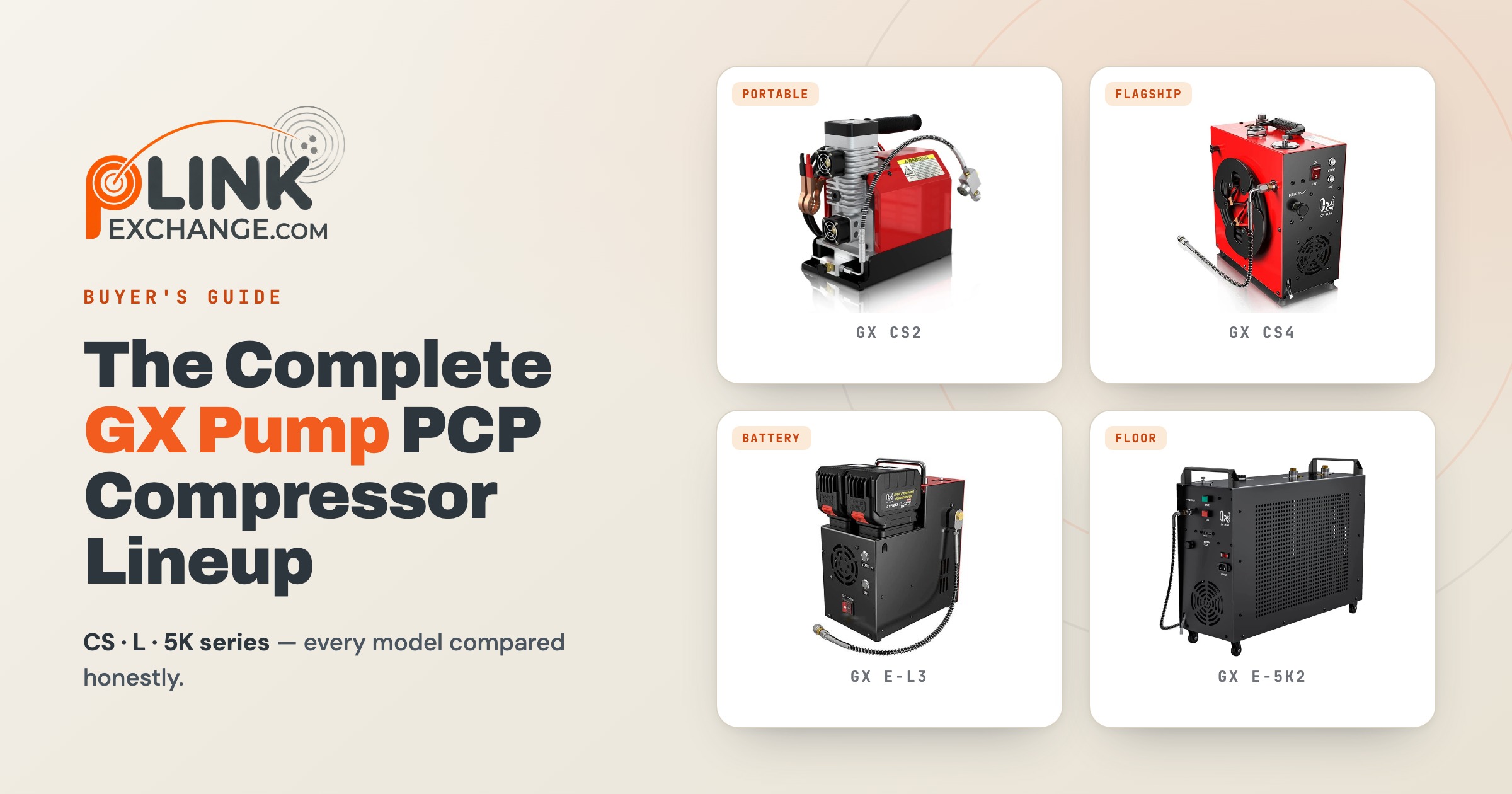
This guide is the manifestation of that research and covers the entire GX lineup relevant to PCP shooters: the portable CS series, the battery powered L series, and the floor standing big dog 5K series. Each model gets the same treatment, in the same order, to try to make things easy to parallel. There is a full comparison table, and a long Q&A at the end that answers the questions I've seen most often in forums (or that I had when I was learning the topic), including the CS2 versus CS3 decision, when a bottle filler actually needs a CS4, etc.
One note that always irks me is that GX's own product pages contradict each other in several places, sometimes on the same page, with the same inconsistencies manifesting on retailer pages. Where that happens, I'll show you both numbers and tell you they conflict rather than simply picking one, and if I have the model in question or access to the model in question, I'll let you know why I'm seeing with my own eyes. Fill time claims are manufacturer figures unless it's called out as an owner-observed claim with any other owner-reported figures labeled as such. Prices are snapshots as of July 2026, not fixed MSRPs, because GX runs constant sales and discount codes and street prices have shifted with tariffs and supply chain challenges through 2025 and 2026.
Shooting it Straight
It's important to note that "GX Pump" is a brand, not a factory. The compression design GX advertises is protected by US Patent 9,726,165 B2, which is legally assigned to Nantong Guangxing Pneumatic Equipment Co., Ltd. of Jiangsu, China, and GX's own corporate page names only trading and ecommerce entities in Shenzhen, Hong Kong, and London. That matters to you as a buyer for two reasons. First, the same pump platform is sold under other names, including the Xisico JTS GX-E-CS3 through Xisico USA in Texas, the Omega Trail Charger and Air Charger through Airguns of Arizona, and the BSA Portable PCP Compressor in the UK, so you may already own a GX without knowing it. Second, first party support runs out of China and is slow, so your realistic support path is Amazon protection plans plus US parts sellers, principally Target Forge.
The lineup breaks into three families. The portable CS series (CS1-I, CS2, CS3, CS3-I, CS4, CS4-I) runs on 12V DC or household AC power and is built to fill airguns directly and charge small bottles. The battery powered L series (E-L2, E-L3) puts essentially the CS2 and CS3 on 18V tool batteries for field use. The floor standing 5K series (E-5K1, E-5K2) is a water cooled, hour-metered machine class built to fill 6.8L to 9L carbon fiber and SCBA sized tanks. Every model in the range is oil free in the sense of having no crankcase oil bath (they run on packed grease instead), every model carries a 1 year warranty, and every model is made in China.
Pressure comes in two tiers. The CS1, CS2, CS3, and L series machines top out at 4500 psi, 300 to 320 bar depending on which page you read. The CS4 and both 5K machines are rated to 5800 psi, 400 bar, though GX itself warns that the supplied burst disc is rated to 350 bar and that nearly all tanks in circulation are 300 bar service pressure products anyway. If you want to fill past 350 bar you can double up the supplied burst discs or do what I did and buy some 6000 psi discs to safely fill Harpoon cartridges to 5000 psi (350 bar).
The community reliability picture is genuinely good for a Chinese compressor. Owners routinely report multiple years and hundreds of hours of service, and shooters who own both a GX and a Yong Heng consistently reach for the GX because it is quieter, cleaner, and self contained, while conceding the Yong Heng fills faster for less money. The consistent complaints are slow China-based customer support, a stretch where parts were hard to find, and a handful of documented failures concentrated in the internal power converter "-I" variants and one problematic CS4 water pump.
If you want the short version of my takes, you have to first understand that I value auto-stop in a way that most will not because I have the attention span of a coked-up ferret and I value the integrated power supply of the "-I" models because it's one less thing to lose.
Here's my quick takes of who these are for:
- The CS1-I is the cheapest, the slowest, and the least sexy option, but my experience with it makes it my recommendation if you're a beginner or occasional shooter directly filling guns with tanks sized 580cc or less at 4000psi or less.
- The CS2 at roughly $269 is a value pick for shooters who only fill guns directly and intently pay attention the entire time. The lack of auto-stop and presence of an external power supply makes this unappealing to me, but it is a reliable value-play and a step-up from the CS1 in terms of speed and robustness.
- The CS3 or CS3-I adds auto stop and a larger case to the CS2 for those who want to walk away (or will wander away) from the machine. This is intended for filling guns directly, but the duty cycle runs long enough to fill and top-off bottles up to 2L or 3L.
- The CS4 and CS4-I are the sweet spot for most serious shooters. Enough to reliably fill and top-off bottles up to 6.8L and quickly direct fill pretty much anything up to 5800 psi. It's quiet and fast with slightly more care and feeding requirements than strictly air-cooled units. More than enough for most hobbyists, hunters, or enthusiasts.
- The E-5K1 or E-5K2 is the answer once you are routinely filling large tanks 9L or larger. The vast majority of PCP owners will never need this level, however, the fill times of the 5K2 definitely elicit "if I had the money," thoughts.
- The battery-powered L series machines are field tools, best owned as a second compressor. They are simply battery powered versions of the CS2 and CS3 and would be appropriate for hunting or other field duty. Although, personally, I'd just bring a 6.8L bottle and enjoy the faster fill times in most situations.
How Every GX Works: The Shared Design
Before the model profiles, it helps to understand what all of these machines have in common, because the differences between models are smaller than the marketing suggests.
Every GX compressor uses a multi stage piston pump turning at relatively low RPM, driven by an electric motor. GX calls the design "oil free", which is true-ish in the narrow sense that there is no crankcase oil bath like you would find in a Yong Heng or a dive compressor. It is not, however, maintenance free. The pistons, bore, connecting rod bearing, and wrist pin are packed with a specialist grease, and most models have a grease pot or grease syringe provision for periodic re-lubrication. A community teardown of the CS2 found a forged steel connecting rod with a caged needle bearing, which reviewers regard as unusually good for the price class, and GX credits the roller bearing at the top of the connecting rod for the line's long service life.
One point of real confusion is that GX's grease guidance has changed across generations of the same product. The first generation CS2 had a grease check port, a later generation removed it and told owners to add nothing during the first year, and current guidance for some models is essentially to leave the grease alone unless fill speed drops. On the water cooled CS4 and 5K machines, GX explicitly warns not to touch the grease knob for the first several hours of use, and on the 5K series the first 50 hours, because over greasing causes damage. Experienced owners fit an inexpensive vibration activated hour meter to every GX they own so they can track run time for grease and service intervals, and I think that is the single best ten dollar accessory you can add. I will note that the CS4-I I purchased from Amazon in March of 2026 had a built in hours-of-service meter, which is awesome.
The other thing to understand is the naming. A "-I" suffix means the 110V to 12V power converter is built into the machine instead of shipping as an external brick. That is the entire difference between a CS3 and a CS3-I, and between a CS4 and a CS4-I. GX says so directly on the CS3-I page. The internal converter is more convenient on a bench, the external converter keeps heat out of the case and costs almost nothing to replace if it dies. I strongly prefer the internal version because it's cleaner and I don't mind opening a case for repairs, but the early internal converter units had a documented run of power supply failures, so i get why much of the community still leans external.
Model Deep Dives
Each profile below follows the same format: what it is, the published numbers, what owners actually report, the weak points, and who should buy it. Manufacturer claims and owner reports are labeled throughout.
GX CS1-I
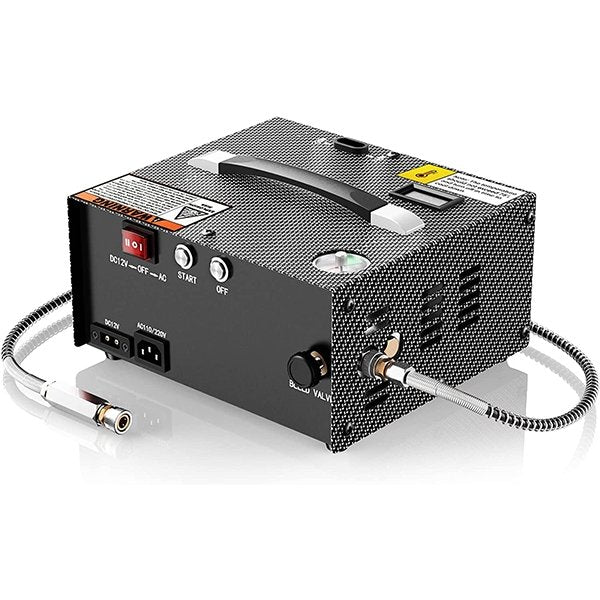
What it is. The CS1-I is the entry point of the current US lineup, a compact fan cooled machine with auto stop and a built in power converter, priced below everything else GX sells. The original CS1 was configured for markets outside the US and commonly rated at 220V, with the CS2 serving as the 110V US equivalent, so the CS1-I is what GX now sells to American buyers at this tier.
The numbers. GX publishes 250W power, a 2700 RPM motor, 9 L/min advertised output, 78 dB working volume, 17.6 lb weight, and a compact 8.9 x 10.5 x 6.1 inch footprint. Power comes from 12V DC or 110V/220V AC through the built in converter, and the machine adds under body LED work lights. Fill claims are a 0.5L vessel from 200 to 300 bar in 7 to 8 minutes and from 0 to 300 bar in 20 to 22 minutes. Official price at the time of writing is $229.99, down from a $339.99 list.
Spec conflicts, noted plainly. The CS1-I page is the messiest in the lineup. The headline and body use 4500 psi and 30 MPa language while the spec block says 320 bar maximum working pressure, and GX's own copy describes the pump as "3.5 stage" in one place and "dual piston and 4 stages" in another. The page also mixes several shutdown conditions, including preset pressure, continuous run time, and an over temperature cutoff. None of this makes the machine unusable, but treat every CS1-I number as a claim rather than a verified figure.
What owners report. Community sentiment consistently steers buyers up to the CS2, with experienced owners calling the CS2 a big step up in quality and noting that the CS1 name is shared by many generic rebadged units, which makes parts identification difficult. One owner ran a CS1 successfully in the field off a car battery, and another reported a failure that they attributed partly to pushing the little pump too hard on a 1.5L bottle.
Weak points. Spec sheet inconsistency, a shallow owner base compared to the CS2 and CS3 (10 visible reviews on GX's own store versus 308 each for the CS2 and CS3), and generic naming that complicates parts sourcing.
Who should buy it. Someone on a strict budget who wants auto stop and built in home power, fills guns directly, understands the limits, and accepts that the CS2 is the better documented machine for $40 more.
Buy the CS1-I on GX Pump | Buy the CS1-I on Amazon
GX CS2
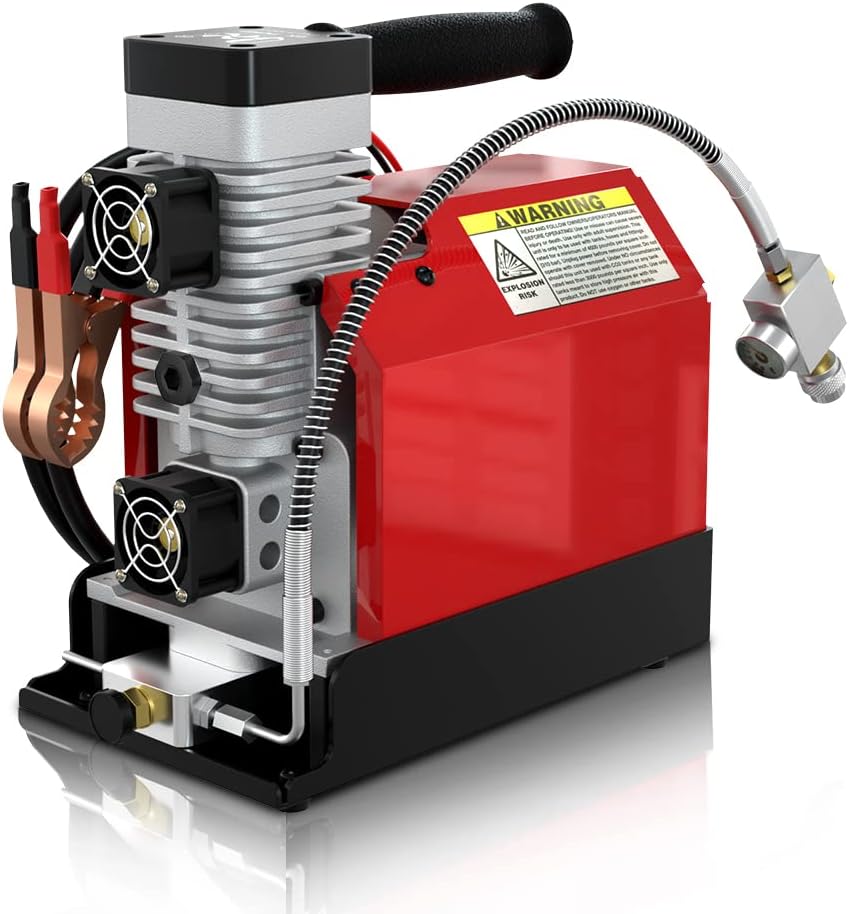
What it is. The CS2 is the value workhorse of the range and one of the two most recommended GX models in the community. It is a manual stop compressor, meaning there is no auto shutoff and you stay on the gauge while it runs, which is the single biggest functional difference from the CS3.
The numbers. GX publishes 250W power ("up to 250W" in some copy), a 2700 RPM motor, 300 bar / 4500 psi maximum, 75 dB noise, 6.7 kg weight, fan cooling, and power from 12V DC or 110V AC through an included external adapter. It ships with an extra external moisture and oil separator the user can choose to install. GX's fill claims are a 0.5L bottle from 200 to 300 bar in about 8 minutes and from 0 to 300 bar in 18 to 20 minutes, and GX explicitly positions the machine for tanks under 60 cubic inches, about 1L, for PCP and paintball use. Official price at the time of writing is $269, from a $469 list, and it is commonly seen around $300 at Walmart and $370 on Amazon.
What owners report. The CS2's reliability reporting is among the best in the line. One owner reported a CS2 in its fourth year with over a thousand fill cycles, and a repair experienced owner who has worked on more than six GX compressors called the CS2 robust and simple in design and operation. Its 308 visible reviews on GX's own store, tied with the CS3 for the most in the lineup, reflect the deepest installed base of any model.
Weak points. No auto stop, so you watch the gauge every fill. The external screw on water filter is bulky, and the gauge box sits at the gun end of the fill line, which some owners find awkward. The community consensus is that this is strictly a gun and small bottle machine and should never be pointed at a large cylinder.
Who should buy it. The shooter who fills rifles directly, values durability per dollar above convenience, and does not mind babysitting an 8 minute fill. If that is you, this is the best $269 in the lineup.
Buy the CS2 on GX Pump | Buy the CS2 on Amazon
GX CS3 and CS3-I
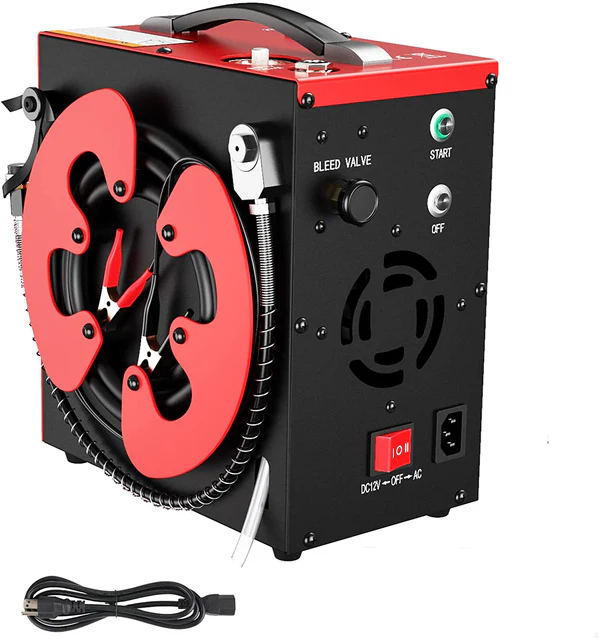
What it is. The CS3 is the CS2's design with auto stop added, in the words of an owner who has serviced many of both. It keeps the same pump architecture and adds a user settable auto stop pressure via an adjustable gauge, an adjustable pressure relief valve, a burst disc, a built in inline water and oil separator, and a wire spool cable management feature covered by a US appearance patent. The CS3-I is identical except the 110V to 12V converter is built into the machine.
The numbers. GX publishes 250W power, a 2700 RPM motor, 300 bar / 4500 psi maximum, 75 dB noise, 7.5 kg weight, fan cooling, and M10x1 plus 8mm quick connect output hardware. Fill claims are a 190cc tank from 1800 to 3300 psi in 2.5 minutes, a 480cc carbon bottle from 1800 to 3500 psi in 7.5 minutes (the CS3-I page says 8.5 minutes for the same fill, a documented conflict between GX's own two pages), and a 0.5L bottle from 0 to 30 MPa in about 18 minutes. Duty cycle is stated as 30 minutes run and 20 minutes cool on the CS3 page but 50 run and 20 cool on the CS3-I page, another internal conflict. GX says the machine is mainly for tanks under 1L, with fills up to 1.5L possible only with cooldown management. Official prices at the time of writing are $359.99 for the CS3 and $379.99 for the CS3-I, with the CS3-I historically listed as high as $529.99 before discounting.
Independent verification. This platform has more third party test data than any other GX because of its rebadges. The BSA badged version was bench tested by Airgun World with published specs of 250W, 2700 RPM, 11 L/min output, 19.8 lb, 320 bar maximum, and a 72 dB working volume. UK review site Tool Dust rated the CS3 4.5 out of 5, measured noise around 75 dB, and confirmed the 30 run 20 cool duty cycle and the auto stop behavior. Owners describe the noise as vacuum cleaner loud, quiet enough to run indoors.
What owners report. The CS3 was the most popular GX portable of its era, matches the CS2's 308 store reviews, and is the basis for the Omega Trail Charger rebadge. Owners treat it as the more convenient sibling of the CS2 rather than a fundamentally different machine, and multi year service reports are common, including a CS3 still running strong past two years with its second owner.
Weak points. The duty cycle and fill time conflicts on GX's own pages, plus the general line wide issues covered later in this guide, chiefly check valve fouling. On the CS3-I specifically, the internal converter adds heat inside the case and is harder to replace than an external brick, which is why reviewer Ronin's Grips and much of the community argue the plain CS3 with external supply is the smarter buy for bench use.
Who should buy it. Anyone who wants the CS2's proven pump but refuses to babysit a fill. The auto stop and adjustable relief valve are a genuine safety layer, not just a convenience. Choose the external supply CS3 if the machine lives on a bench, and the CS3-I only if the single cable setup is worth $20 and the converter tradeoffs to you.
Buy the CS3 on GX Pump | Buy the CS3 on Amazon
Buy the CS3-I on GX Pump | Buy the CS3-I on Amazon
GX CS4 and CS4-I
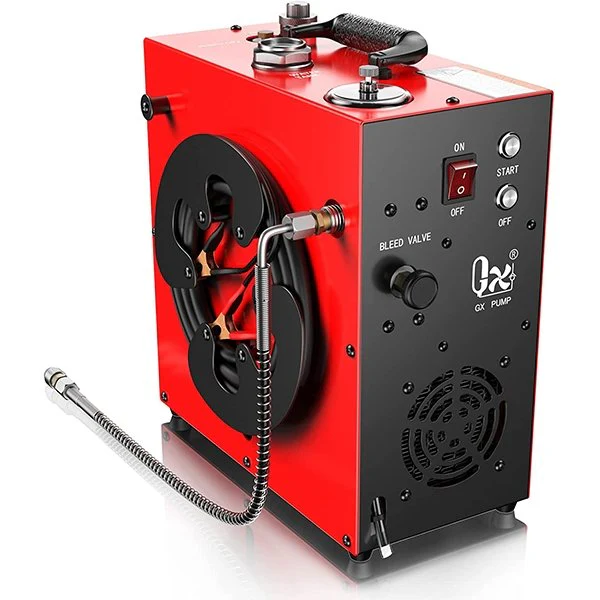
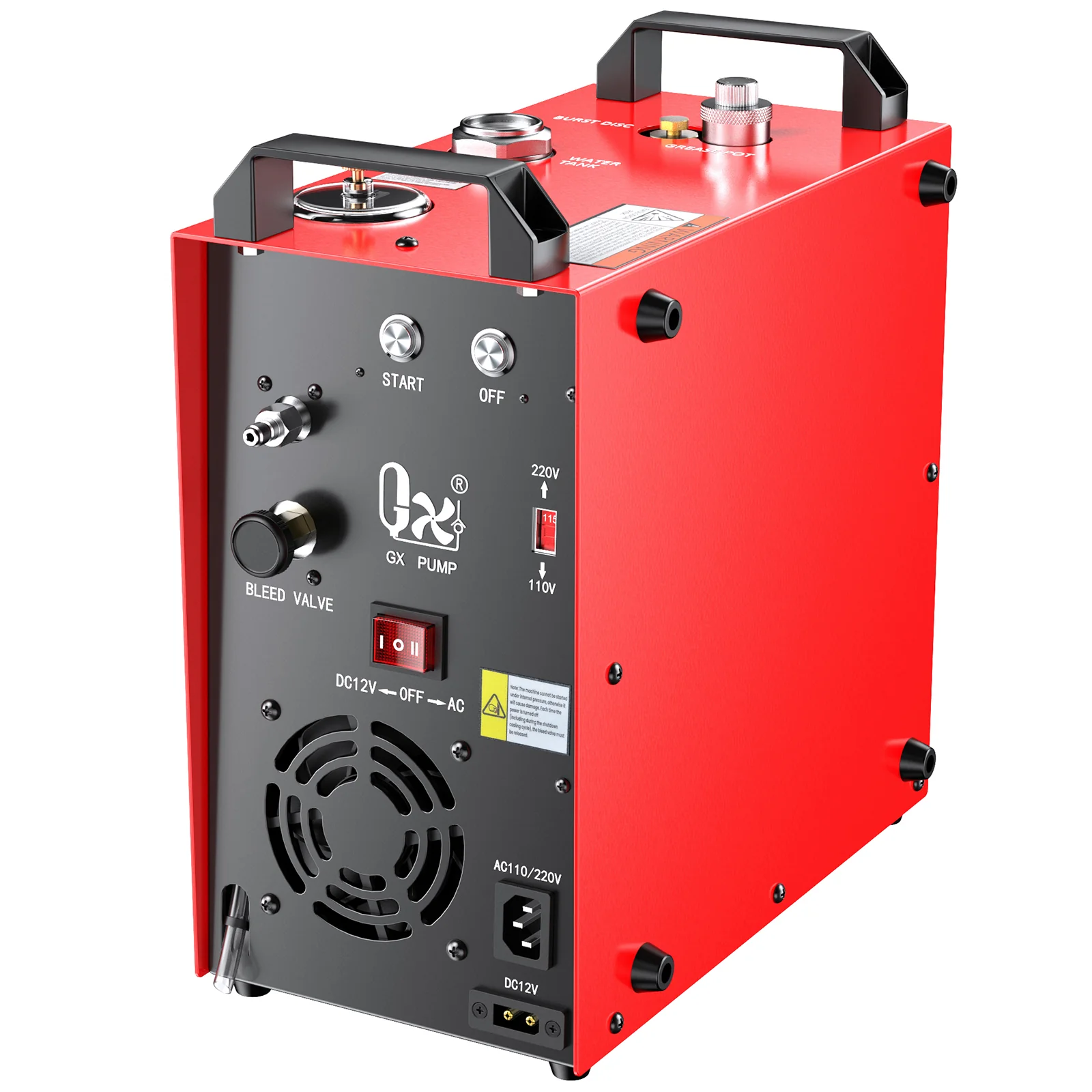
What it is. The CS4 is the current flagship portable and, in our assessment, the sweet spot for most serious shooters. Unlike the CS3, it is a genuinely different machine, not a trim level: a four stage compression system with an integrated closed loop water cooling circuit (top mounted water tank, internal water pump, radiator, and cooling fans), a 350W motor, a double pointer gauge with two level auto stop, a top mounted grease pot, and a Foster/8mm quick connect detachable air line. This is where GX moves from rifle top off tool to a home compressor for both guns and modest bottles. The CS4-I is the same machine with the converter built in, plus a built in oil water separator GX says does not require replacement.
The numbers. GX publishes 5800 psi / 400 bar maximum design pressure, 2700 RPM, 11 L/min air output, 70 dB noise, 4 to 5 hours continuous runtime (5 hours on the CS4-I page), and a 6.8L maximum cylinder capacity. Fill claims are a 0.5L tank from 3000 to 4500 psi in 4 to 5 minutes, from 0 to 4500 psi in 14 to 16 minutes, and a 6.8L bottle from 0 to 4500 psi in 2 hours 40 minutes. Listed size is 11.8 x 6.1 x 12.4 inches. Weight is published as 29 lb in one section of GX's page and 33 lb in the formal spec block, a conflict, and coolant guidance varies between 300 ml and 500 ml across GX's page and external listings. Official prices at the time of writing are $589.99 for the CS4 and $689.99 for the CS4-I, with 2025 street data from owners showing the CS4 around $495 to $550 shipped direct with a 10% code and the CS4-I around $560 to $625.
The burst disc caveat, in plain terms. Although the CS4 is rated to 400 bar by design, the burst disc GX supplies is rated to 350 bar, so filling above 350 bar blows the disc unless you buy the higher rated 400 bar disc separately. GX also notes that almost all tanks on the market should only be filled to 300 bar service pressure regardless. The practical value of the 400 bar ceiling is not that you will fill to 400 bar, it is that the pump is loafing at 300 bar instead of working flat out, and that it can reach the fill pressures of high pressure guns like the Huben K1.
What owners report. Community deadhead tests are striking, with owners reporting the pump reaching 300 bar against a plugged line in 22 to 28 seconds. A 9L class tank can be topped in reasonable time, though a full 9L fill from empty runs roughly 3.5 hours, which tells you the 6.8L rating is the honest ceiling. Reviewers repeatedly call it the quietest compressor they have owned. Forum owners recommend it specifically when the conversation shifts from topping off a rifle to filling both guns and bottles with one machine.
Weak points. Documented failures include a dead water pump on at least one unit, the line wide check valve fouling issue, and internal power supply failures on early CS4-I units that GX has since addressed. The weight and coolant spec conflicts on GX's own page are worth knowing about. And at 29 pounds plus, portable is a relative term.
Who should buy it. Most serious shooters, honestly. If you own more than one PCP, fill a 0.5L to 6.8L bottle with any regularity, or shoot a 300 bar plus gun, the CS4 with the external power supply at roughly $495 to $550 direct is the best balance of capability, noise, duty cycle, and price in the lineup. Add the GX external filter and an hour meter and this is a machine you can plan around. We lean external supply over the CS4-I for the roughly $100 savings and the easier power path repair.
GX E-L2
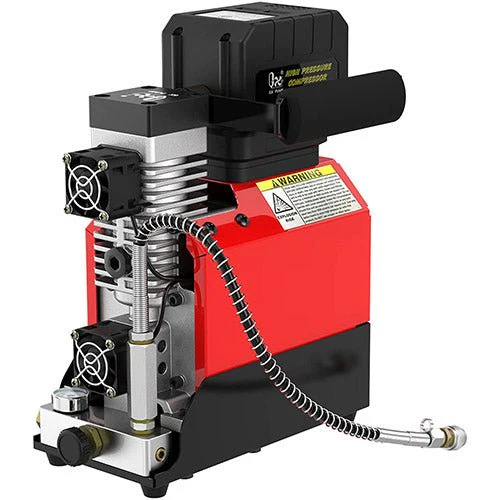
What it is. The E-L2 is the purest field portability play in the lineup, described accurately by the community as a battery powered CS2. It runs off a single 18V 7.8Ah lithium battery, with Makita compatibility reported by owners, or an optional 110V to 18V converter sold separately, and like the CS2 it is a manual stop machine.
The numbers. GX publishes 250W power, a 3000 RPM motor, 300 bar / 4500 psi maximum, fan cooling with an inline moisture filter, and 6.53 kg net weight, though GX's own comparison graphic shows 7.6 kg with the battery installed, so store those as two different numbers. Fill claims are a 0.5L bottle from 200 to 300 bar in 4 to 5 minutes and from 0 to 300 bar in 13 to 14 minutes. One battery charge runs the pump 30 to 35 minutes, which GX says is enough for roughly eight 0.5L fills from 1000 to 3000 psi or about five top offs from 3000 to 4500 psi. GX advises against tanks over about 60 cubic inches and recommends cooling after 25 to 30 minutes of work. Official price at the time of writing is $319.99, with street pricing seen around $399.99.
What owners report. Owner reports are thin, four visible reviews on GX's store, but positive, including one owner describing a flawless two years. The realistic use pattern is tree stand, field blind, range bag, or truck box top offs.
Weak points. Manual stop in a field context means you are watching a gauge while you should be watching a squirrel or raccoon. The single battery limits runtime, and this is a gun and sub 1L bottle tool only.
Who should buy it. A hunter or field shooter who wants top off capability with no vehicle battery and no carbon bottle, and who already owns or plans to own a bench compressor. This is a second compressor, not a primary option.
GX E-L3
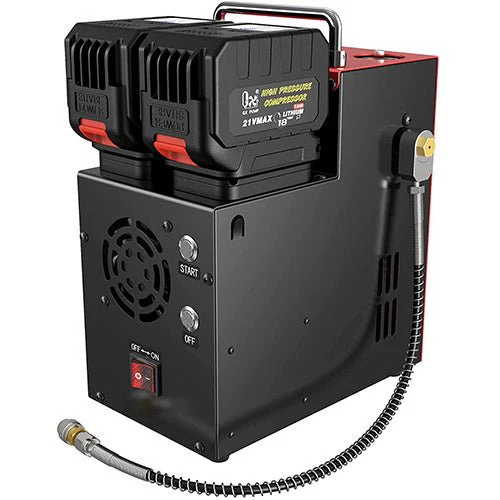
What it is. The E-L3 is the most interesting specialist in the catalog because it marries true cordless operation with auto stop, which the E-L2 lacks. It runs two 18V batteries, one charging while the other works, adds a set pressure auto shutoff, a built in oil water separator, and a high power fan, and is rebadged as the Omega L3 in some markets.
The numbers. GX publishes 250W power, a 3000 RPM motor, 14 L/min output, 72 dB noise, 320 bar / 4500 psi / 32 MPa maximum, 17.8 lb net weight, roughly one hour of combined runtime from the two batteries, and a 1L maximum tank recommendation. Fill claims are a 500cc bottle from 20 to 30 MPa in about 4 minutes and from 0 to 30 MPa in about 13 minutes. GX suggests resting the pump 10 minutes after 15 minutes of use. The kit ships generously, with two batteries, two chargers, a pull rod, sockets, wrenches, a spare first stage piston ring, springs, and ten burst discs. Official price at the time of writing is $389.
A claim worth flagging. GX's published 14 L/min output is higher than the official CS4 figure of 11 L/min despite the E-L3's lower power and simpler fan only cooling. That does not make the E-L3 a bad machine, but treat the output figure as a manufacturer claim awaiting independent confirmation.
What owners report. Owners report filling a 500cc bottle from 200 to 300 bar in under 4.5 minutes and reaching 320 bar on a Huben K1, both of which track the claims. One three year owner reported a straightforward DIY rebuild covering the main piston seal, o-rings, greasing, and the two small cooling fans. Hard Air community members describe it as really small and ideal for top offs at home or in the field, and Gun Mart's review called it a robust, well thought out kit. Notably, at least one owner pairs it with a CS4 class home machine rather than trying to make it do everything, which is the right mental model.
Weak points. Thin owner base (four store reviews), the unverified output claim, and the same sub 1L ceiling as every other 250W machine in the line.
Who should buy it. The field shooter who wants the E-L2 concept without the manual stop compromise, and who values the dual battery, auto stop, generous kit package enough to pay about $70 more than the E-L2.
GX E-5K1
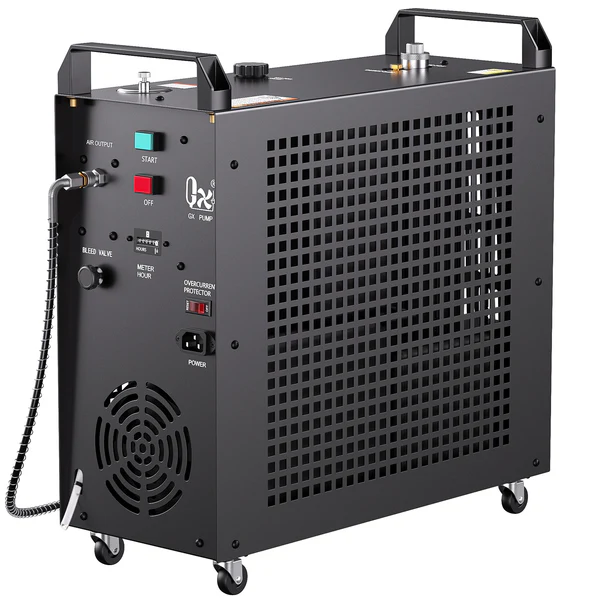
What it is. The 5K series is GX's do it all tier: floor standing, mains only, water plus fan cooled, hour metered machines built to fill large tanks. The E-5K1 is the single cylinder, 900W version.
The numbers. GX publishes 5800 psi / 40 MPa maximum, 110V AC power, a 10 hour continuous work rating, water and fan cooling, and a moisture filter, and claims the machine can charge almost all sizes of PCP, paintball, and scuba tanks on the market, even over 20L, with a rifle filled directly in 3 to 4 minutes. It lacks the auto purge feature the 5K2 has. Owner reported pricing runs around $900 delivered direct.
What owners report. Owners report the 5K1 tops off a 9L tank from 200 to 310 bar in about 30 minutes and fills a 9L from empty to about 4600 psi in about 177 minutes. Owners also note it runs quieter than the little fan cooled CS2 class units, which sounds backwards until you remember water cooling and a low stress duty point.
Weak points. Floor unit size and weight, mains only power, no auto purge, and the same China based support situation as the rest of the line. Like every GX, it is not certified for breathing air, and GX states that explicitly.
Who should buy it. The shooter who routinely fills 6.8L to 9L tanks, or fills for a family or small group, and wants the large tank capability at the lowest price GX offers it.
GX E-5K2
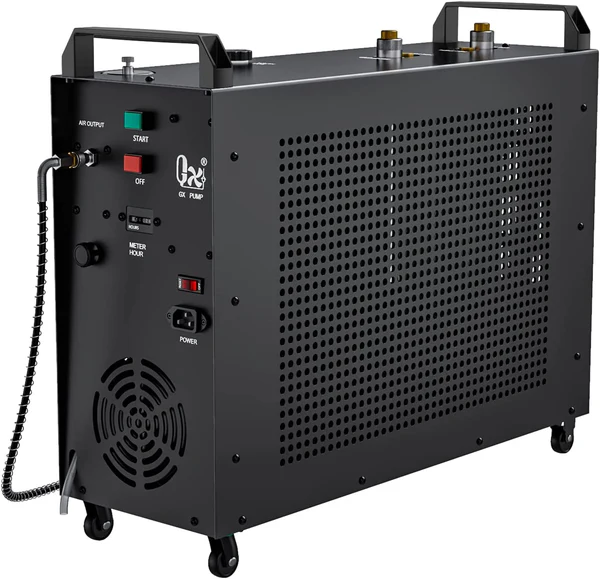
What it is. The E-5K2 is the top of the GX range, a dual piston, four stage, 1200W floor machine built for the biggest tanks and the longest sessions.
The numbers. GX publishes 5800 psi / 40 MPa maximum, a 1200W motor (retailer AirgunDirect notes it draws about 1200 to 1500 watts and runs on a standard 110V circuit rather than requiring 220V), 10 hours continuous work, auto stop with auto purge, and a cooling system built around a high capacity water tank with a built in water pump, radiator, powerful fan, and an external water level indicator. It ships with a complete set of seals and o-rings, wheels, and a water separator, and GX claims a PCP gun fills directly in 2 to 3 minutes. Owner reported pricing has ranged from a historical $1,700 to $2,300 down to recent sales just under $1,000 to around $1,200.
What owners report. Owners report filling a 9L tank from 240 to 310 bar in about 16 minutes, deadhead to 300 bar in roughly 24 seconds, and 40 plus trouble free hours on the meter. Noise reports are remarkable for the class, with one owner calling it quieter than the fans blowing around the house and another describing it as a loud dishwasher.
Weak points. One owner estimates roughly 100 lb dry, there is no external coolant drain, which means opening the case to change coolant, and like the 5K1 it is not certified for breathing air. It is frequently cross shopped against the Omega Turbocharger, with which it shares a manufacturer suspicion, and against the Hill EC-3000/Evo-310 and entry Alkin and Coltri machines for buyers who want first party western support.
Who should buy it. The high volume tank filler, the club member who fills for others, or the shooter who wants one machine that never breaks a sweat. At its recent sale pricing near $1,000 it is arguably the best value in large tank filling short of a used dive compressor.
Master Comparison Table
Manufacturer claims unless labeled otherwise. Cells marked "not published" mean GX has not released the figure and no reliable third party measurement exists, and we do not fill those with guesses. Where GX's own pages conflict, both figures are shown.
| Spec | CS1-I | CS2 | CS3 | CS3-I | CS4 | CS4-I | E-L2 | E-L3 | E-5K1 | E-5K2 |
|---|---|---|---|---|---|---|---|---|---|---|
| Family | Portable entry | Portable value | Portable auto-stop | Portable auto-stop | Portable flagship | Portable flagship | Battery field | Battery field | Floor, water-cooled | Floor, water-cooled |
| Max pressure | 320 bar spec block; page also says 4500 psi / 30 MPa (conflict) | 300 bar / 4500 psi | 300 bar / 4500 psi (BSA version tested 320 bar) | 300 bar / 4500 psi | 5800 psi / 400 bar design; stock burst disc 350 bar | 5800 psi / 400 bar design; stock burst disc 350 bar | 300 bar / 4500 psi | 320 bar / 4500 psi / 32 MPa | 5800 psi / 40 MPa | 5800 psi / 40 MPa |
| Stop mode | Auto-stop | Manual | Auto-stop, settable | Auto-stop, settable | Auto-stop | Two-level auto-stop | Manual | Auto-stop | Manual (no auto purge) | Auto-stop + auto purge |
| Motor / power | 250W, 2700 RPM; stages listed as "3.5" and "dual piston / 4" (conflict) | 250W, 2700 RPM | 250W, 2700 RPM | 250W, 2700 RPM | 350W, 2700 RPM, 4 stages | 350W, 4 stages | 250W, 3000 RPM | 250W, 3000 RPM | 900W, 1 piston / 4 stages | 1200W (draws ~1200 to 1500W), 2 pistons / 4 stages |
| Air output | 9 L/min | not published | not published (BSA version 11 L/min) | not published | 11 L/min | not stated separately | not published | 14 L/min (flagged, exceeds CS4 claim at lower power) | not published | not published |
| Cooling | Fan | Fan | Fan | Fan | Water + fans, closed loop | Water + fans, closed loop | Fan | Fan (dual) | Water + fan | Water + fan |
| Power source | 110/220V AC (built-in converter) or 12V DC | 12V DC or 110V AC via external adapter | 12V DC or 110V AC via external converter | 12V DC or 110V AC, built-in converter | 12V DC or 110V AC via external converter | 12V DC or 110V AC, built-in converter | 1x 18V battery or optional converter | 2x 18V batteries | 110V AC only | 110V AC only |
| Tank guidance | no clear max published | under 60 ci; not over 1L | mainly under 1L; 1.5L with cooldown | mainly under 1L; 1.5L with cooldown | up to 6.8L | up to 6.8L | not over 1L (comparison graphic says under 0.7L) | 1L maximum | large tanks, even over 20L | large tanks, even over 20L |
| Headline fill claim | 0.5L, 200→300 bar, 7 to 8 min | 0.5L, 200→300 bar, ~8 min; 0→300 bar, 18 to 20 min | 190cc, 1800→3300 psi, 2.5 min; 480cc, 1800→3500 psi, 7.5 min | same platform; 480cc claim 8.5 min (conflicts with CS3 page) | 0.5L, 3000→4500 psi, 4 to 5 min; 6.8L, 0→4500 psi, ~2h40 | same as CS4 | 0.5L, 200→300 bar, 4 to 5 min | 500cc, 20→30 MPa, ~4 min | rifle 3 to 4 min; 9L 200→310 bar ~30 min (owner) | rifle 2 to 3 min; 9L 240→310 bar ~16 min (owner) |
| Duty cycle / runtime | auto-stop; 25 min continuous / 85°C note on page | cool after 25 to 30 min | 30 min run / 20 min cool | page says both 50/20 and 30/20 (conflict) | 4 to 5 hrs continuous | 5 hrs continuous | 30 to 35 min per charge | ~1 hr on two batteries; rest 10 min per 15 min advised | 10 hrs continuous | 10 hrs continuous |
| Noise | 78 dB | 75 dB | 75 dB (Tool Dust measured ~75; BSA version 72) | 75 dB | 70 dB | 70 dB | not published | 72 dB | quieter than CS2 (owner) | "loud dishwasher" (owner) |
| Weight | 8 kg / 17.6 lb | 6.7 kg | 7.5 kg (BSA version 19.8 lb) | 7.5 kg | 29 lb and 33 lb both on page (conflict) | 29 lb | 6.53 kg body; 7.6 kg with battery | 17.8 lb / 8.2 kg | not published | ~100 lb dry (owner estimate) |
| Lubrication | oil-free / grease | oil-free / grease | oil-free / grease | oil-free / grease | oil-free / grease + grease pot | oil-free / grease + grease pot | oil-free / grease | oil-free / grease | oil-free / grease + grease pot | oil-free / grease + grease pot |
| Warranty | 1 year | 1 year | 1 year | 1 year | 1 year | 1 year | 1 year | 1 year | 1 year | 1 year |
| Official price (July 2026 snapshot) | $229.99 | $269.00 | $359.99 | $379.99 | $589.99 (street ~$495 to $550 w/ code) | $689.99 (street ~$560 to $625) | $319.99 (street ~$399.99 seen) | $389.00 | ~$900 delivered (owner) | ~$1,000 to $1,200 recent; $1,700 to $2,300 historical |
| Store review count (July 2026) | 10 | 308 | 308 | 85 | 37 | 14 | 4 | 4 | n/a | n/a |
| Breathing air certified | No | No | No | No | No | No | No | No | No | No |
The Bottom Line
The GX lineup earns its popularity honestly. The pumps are quiet, clean, well built for the money, and backed by a real US parts pipeline through Target Forge even if GX's own support is not much help a lot of the time. Buy the CS2 if you want maximum durability per dollar and will watch the gauge, the CS3 if you want to walk away, the CS4 if you are serious about this and fill anything bigger than a rifle, and a 5K if big tanks are your routine. Keep the battery machines in their lane as field tools, keep every GX out of the breathing air business, put an hour meter on whatever you buy (unless it's a newer model with it built-in), and clean that check valve before it cleans out your sanity.
Specifications and prices in this guide are snapshots from GX's official pages and community reporting as of July 2026, with manufacturer spec conflicts preserved and flagged rather than reconciled. If you spot a change or have owner data that confirms or contradicts a figure here, we want to hear about it.
GX Pump compressor questions, answered
The questions we see most often about choosing, buying, and maintaining a GX Pump PCP compressor.